
The First 90 Days Decide Whether Security Will Be Managed or Reactive

Written by: Rob Chadwick
The first 90 days of a data center build should establish the management system that will govern security as the site becomes more complex. Cameras, drones, access platforms and response tools will change over the life of the project. The management system determines how those capabilities are selected, operated, tested and changed.
By Day 90, the project should know who owns the security picture, what information needs to move between organizations, how exceptions are escalated, what leadership needs to see, and which construction milestones trigger another review of the plan.
In our recent piece, After Entitlement, the Constraint Moves, we argued that active construction changes the security problem. The first 90 days are where the project builds the operating discipline to keep changing with it.
Days 0–30: Establish ownership before complexity arrives
The early site may look relatively simple. That makes it the right time to settle questions that become harder to answer once the workforce, perimeter and schedule are changing every day.
By Day 30, three things should be established. First, one person needs clear ownership of the security operating plan and enough authority to act when something does not line up. Second, the project needs a validated site baseline built from the physical site as it actually exists, rather than relying only on drawings or the original plan. Third, the escalation path needs to be mapped end to end, with each step tied to an actual person who knows what decision they own.
“By Day 30, one person needs the authority to act on that mismatch immediately.” - Rob Chadwick
This is also the time to bring security infrastructure requirements into the construction conversation. Power, connectivity, mounting locations, network approvals, environmental conditions and commissioning requirements can determine whether a capability is easy to deploy later or becomes something the project has to work around.
By Day 30, leadership should have an accountable owner, a site baseline verified against current conditions, a defined escalation path and a clear understanding of the security infrastructure requirements that need to move forward with the build.
Days 31–60: Build the information flow
As subcontractors multiply and temporary access points change, security becomes increasingly dependent on information. Who is on site? What are they authorized to do? Which areas are sensitive today? Where are exceptions accumulating? Who can verify an alert? Who needs the answer?
Workforce visibility often becomes more difficult where the owner has less direct line of sight into the labor structure. Lower-tier subcontractors brought onto the project through someone else’s contract are a common example. An early warning may be a mismatch between what a credential allows and what the person is actually doing on site that day.
A badge can confirm that access has been granted. A useful operating picture goes further. Leadership should be able to understand who the worker is, where that person sits in the subcontractor chain, what they are qualified and authorized to do, where exceptions exist, and how that information connects to activity across the site.
The objective is straightforward: give the people responsible for decisions a reliable answer quickly enough to act.
By Day 60, the project should understand how workforce, access, alert and incident information moves between the owner, GC, subcontractors and security team, including who owns an exception when the information does not line up.
Days 61–90: Test the operating model before the stakes rise
By the third month, the project should stop assuming the operating model works and start proving it.
Walk the current perimeter. Review open workforce exceptions. Audit a sample of active credentials against current authorization, subcontractor chain and scope of work. Run an unannounced trigger and time the process from detection through verification and escalation. Then repeat the exercise off-hours, when the people involved have not been primed for a drill.
“A documented process and a tested one are definitely not the same thing.” - Rob Chadwick
This is also the time to establish a small management dashboard. Its purpose is to show leadership whether the security program is keeping pace with the build.
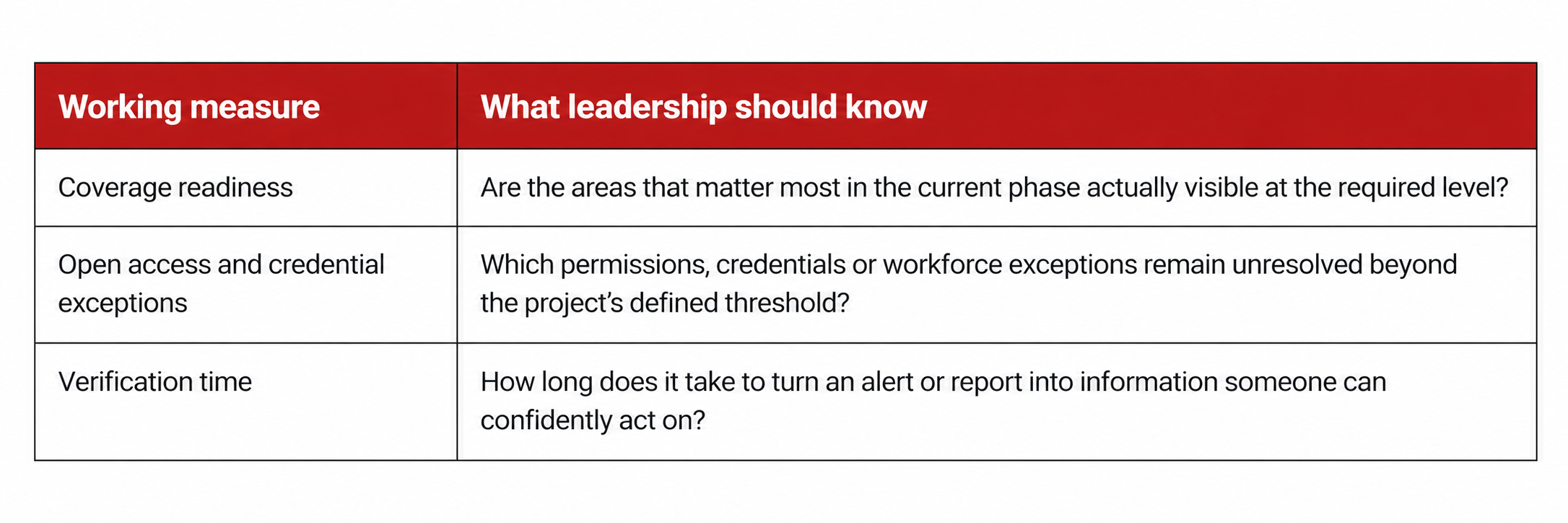
The distinction between activity and useful management information matters. Total alerts, access events and cameras online can indicate the scale or activity level of a system. Leadership gains more useful insight from the exceptions that remain unresolved, the visibility gaps that persist and the time required to turn an alert into a verified answer.
Measure exceptions, not activity.
By Day 90, the project should have tested its escalation and verification process, audited its workforce information, identified gaps in the operating picture and scheduled the next phase-based security review.
Build a security system that recognizes change
The first 90 days cannot predict every security issue a project will encounter. They can create a system capable of recognizing when conditions have changed and triggering the next decision.
A managed program already knows who owns the picture, what information matters, how verification becomes response and when the plan needs to change.
The first 90 days do not decide all of your technology. They decide whether the program will be managed.
That management system is the starting point. In our upcoming white paper, After Entitlement: The Security Decisions That Keep a Data Center Build Moving, we extend this framework across mobilization, vertical construction, critical deliveries, commissioning and handoff, with a practical Security Resource Plan leaders can use before major project milestones.
Is your security operating model keeping pace with the build?
A DXD Build Security Readiness Review compares your current visibility, access, verification and response posture to the phase your project is entering.
The complimentary 30-minute working session is followed by a short gap summary identifying where the plan and the project may have drifted, along with the smallest credible next step to address it.
Request a Build Security Readiness Review
https://www.deusxdefense.com/contact
