
Written by: Rob Chadwick. Contributing field perspective by Matt Smith, CSP | Construction Safety Executive
Executive summary
Data center projects enter construction with significant economic exposure already committed. In its 2026 Global Data Center Outlook, JLL reported that 57% of data center projects experienced construction delays of three months or more in 2025. It also forecast a global average shell-and-core construction cost of $11.3 million per megawatt for 2026, excluding tenant technology fit-out. These figures describe the project environment. They do not assign those delays to security failures. [1]
The relevant security question is narrower and more useful: which uncertainties can the security operating model reduce at each milestone, and what level of capability is justified by the consequence of an interruption? An owner may need reliable visibility at a newly relocated gate, faster verification of a delivery discrepancy, tighter controls around equipment held offsite, or a controlled transition from trade access to partial occupancy. Each problem has a different owner, timing, operating cost and failure mode.
This paper provides a Security Resource Plan for making those decisions. It combines current market research with Rob Chadwick’s field judgment and construction-phase insights contributed by Matt Smith, CSP, a construction safety executive. It is designed for project executives, owners, GCs, security leaders and incoming operations teams who must decide what to resource now, what to test next and what must change before the next phase begins.
The core recommendation is to run security through the same project discipline used for other critical resources: identify the requirement, assign a decision owner, select capacity, verify readiness, prepare a fallback and revisit the decision when conditions change.
1) The execution environment makes security planning consequential
Data center construction operates under overlapping constraints: power availability, workforce capacity, long-lead equipment, site logistics and phased turnover. JLL’s 2026 report notes that developers may preorder select materials as much as 24 months in advance and that large developers and operators are carrying six to twelve months of strategic inventory for critical components. The average U.S. data center equipment lead time reported by JLL was 42 weeks, 83% above its 2019 level. These are sector-level indicators, and individual component lead times vary. [1]
The workforce constraint is measurable as well. In a September 2026 survey released by the Associated General Contractors of America and NCCER, 28% of responding firms said they had worked on a data center project during the prior twelve months. Among that subset, 58% said data center projects increased competition for skilled workers. Across all survey respondents, 42% reported a project delayed because of shortages among their own workers or subcontractors. These results describe contractor experience across a survey population; they are not estimates of security-related losses. [2]
Taken together, the evidence points to a project-management problem. When a critical component must be replaced, workers are reassigned, or zones become available late, the project has fewer easy recovery options. Security has a defined role where access problems, blind spots, unclear custody, slow event verification or disputed handoffs could add avoidable friction to those already constrained flows.
A useful assessment starts with a consequence path. For a potential event, identify what could happen, who would discover it, how quickly the facts could be verified, what decision would follow and which scheduled activity could actually be affected. A minor perimeter event with no critical-path implication should be handled proportionately. A missing item needed for energization warrants a different operating posture. This distinction keeps resources matched to consequence rather than activity volume.
2) The Security Resource Plan: ten decisions to make before the next milestone
The Security Resource Plan is a decision tool for the owner, GC, security team and eventual operator. It should be reviewed before mobilization and again when the project changes sequence, expands access, receives critical equipment or begins to transfer control of a space. The questions below establish the plan.
Demand: Which people, assets, activities and zones need protection during this phase, and what failure would matter to the project?
Timing: Which milestones create new security requirements, and how far ahead must the project commit resources?
Capability: Which combination of personnel, procedures, cameras, access controls, aerial visibility and response can meet the verified requirement?
Reliability: Which capabilities have been tested on this site under expected operating conditions, including after hours?
Full cost: What will design, installation, staffing, training, operations, maintenance and retirement cost across the phase?
Capacity: Can the organizations involved staff, train and operate the system at projected workforce and delivery volumes?
Constraints: Which client standards, privacy requirements, permits, insurance terms, labor arrangements and operational rules apply?
Schedule variation: What changes when a milestone accelerates, slips, overlaps or moves to a different work zone?
Failure contingency: Who acts when a camera, network, guard post, credential service, communications link or promised drone capability is unavailable?
Transition: Which temporary capabilities should be transferred, integrated or retired when permanent systems and operations assume control?
Each answer should produce a record: the decision, accountable owner, evidence supporting readiness, operating cost, fallback and next review trigger. If a decision has no owner or cannot be tested, it remains an open project item. The value of the framework is that it makes these gaps visible while the project still has options.
The plan is intentionally technology-neutral. A drone may be the quickest means of verifying a large changing area; a guard may be necessary for access control, intervention and human judgment. A fixed camera may be the most reliable coverage for a stable zone. The right capacity is defined by the task and the ability to operate it consistently.
3) Equipment risk follows the project beyond the perimeter
A traditional site boundary does little for equipment that has been purchased months before installation and is stored in a separate yard or warehouse. Matt Smith, CSP, a construction safety executive, described the growing practice of buying electrical equipment in bulk ahead of need and holding it offsite. As the equipment moves, its exposure moves. A project can have adequate site coverage while its next critical delivery remains outside the usual security operating picture.
Smith identified late storage decisions as a recurring problem. Last-minute revisions to where critical components are held can alter the exposure to theft, damage or tampering after an initial security plan has been developed. Design changes may shift secured areas and equipment locations. An accelerated schedule can increase the number of people, deliveries and movements in a compressed period. Each change requires an updated resource decision, since the plan was sized for earlier conditions.

JLL’s reporting on extended ordering cycles and strategic inventory supports the operational relevance of this problem. It does not show how frequently theft or security failures cause delay. The security case should therefore be built at the component level: is the item replaceable within the remaining float, who holds custody, what physical controls are in place, and what evidence is required to release it for installation? [1]
For an item linked to a critical milestone, the receiving plan should establish its route, arrival window, identity and condition check, receiving authority, secure storage location, access permissions, incident contact and handover record. This applies whether the equipment is on the construction site or at an offsite holding location. The owner and GC can then see which gaps create real schedule exposure and which can be accepted.
One practical output is a critical-equipment custody register. Record the item or equipment class, next use date, custodian, location, authorized handlers, delivery evidence, damage/escalation path, verification status and alternate plan. Update the record when the item changes hands, changes location or moves into a newly secured space.
4) Manage workforce access as site responsibilities change
Workforce pressure makes accurate access information more valuable. The 2026 AGC/NCCER findings describe a market in which contractor capacity and qualifications are under strain. On a large construction project, that pressure interacts with a tiered subcontractor structure, temporary work zones and frequent scope changes. [2]
Rob Chadwick’s operating observation is that a blind spot often appears below the contracting tier an owner can see directly. A credential may permit entry even though the worker’s current scope, subcontractor relationship or work location has changed. The important exception is a mismatch between current authorization and actual work, especially when no one has clear authority to resolve it.
Federal OSHA guidance for multiemployer worksites emphasizes communication and coordination among host employers, contractors and subcontractors because the activities of one organization can affect the safety of workers employed by another. Security teams can support that coordination with current, usable access information while safety and construction leadership retain their respective responsibilities. [3]

Smith’s construction safety perspective makes the consequences particularly clear during partial occupancy. Trade workers may still need approved access to completed rooms for punch-list work, while owner personnel must be kept out of active construction zones where they may not recognize the hazards. The project therefore needs controls that track the current boundary and the purpose of each access permission.
For each sensitive work zone, the GC, security lead and owner should be able to establish who sponsors the work, which personnel are approved, what task and time window apply, and who can approve or revoke an exception when conditions change. These answers should be recorded and updated with the work, especially as completed areas enter commissioning or owner occupancy.
Assign a named exception owner and a defined resolution threshold. An unresolved mismatch in a live-system room carries different urgency from a minor credential correction in a general laydown area. The threshold should follow consequence, and reviews should emphasize aged or materially sensitive exceptions rather than raw badge-event counts.
5) The operating system: ownership, verification and a small dashboard
A management system can be established before the site becomes busy. By the first phase review, designate one accountable owner who can act on a mismatch without waiting through a long chain of informal approvals. Walk the actual perimeter, access routes and priority zones against the drawings. Document an escalation route that leads to named people, with alternates for off-hours operations.
Rob Chadwick recommends testing the process in the field. A useful exercise introduces an unannounced event, measures time from detection to verified information and follows the escalation path to an authorized decision. Repeat the exercise outside standard business hours. Audit a sample of active badges against current authorization, subcontractor affiliation and scope of work. The test should expose whether the process works when normal personnel are absent or conditions differ from the plan.
Three executive measures are especially useful:
Coverage readiness: Are the zones that matter in the current phase actually visible at the required level? Evidence comes from a current walk, test or verified operational check, including temporary obstructions and shifted boundaries.
Aged access and credential exceptions: Which permissions, qualifications or workforce records remain unresolved beyond a project-defined threshold, and do any involve sensitive zones or live systems?
Verification time: How long does a report or alert take to become actionable, corroborated information in the hands of a person authorized to decide?
These are proposed management indicators, not published industry performance benchmarks. Raw counts of alerts, badge events and online cameras measure scale or activity. Aged exceptions, real coverage gaps and time to useful confirmation tell leadership where a decision may be required. Define targets against the project’s actual requirements and test them before treating them as commitments.
The review cadence should follow the construction look-ahead. Weekly operating checks can catch changing access or coverage. Formal phase reviews should occur before critical deliveries, substantial site redesign, commissioning and partial occupancy. A decision log prevents each new team from rediscovering the same unresolved issue.
6) Match the operating model to the phase of the build
The phases below describe decision points, not a universal construction sequence. Some projects will overlap phases or bring individual rooms and systems online in waves. At each transition, the project team should confirm the changed condition, the security requirement, the accountable owner and the evidence that the plan is ready.
Pre-mobilization. Security requirements can still be integrated into the construction plan with relatively low disruption. Confirm decision rights, emergency response, access philosophy and constraints on mounting, power, connectivity, network approvals and equipment siting. Identify which future capabilities require irreversible site decisions.
Site preparation and mobilization. Temporary gates, fencing, grading and material staging continuously change the actual boundary. Establish a repeatable walk of current approaches, line of sight, authorized access routes and response travel. Update the baseline whenever earthwork or logistics changes the site geometry.
Vertical construction. Headcount and subcontractor turnover increase, and access becomes more granular. Build a current record of workforce identity, sponsor, qualification and access scope. Review exceptions at a cadence that fits the volume and sensitivity of work. Test who can resolve a mismatch in real time.
Critical deliveries and fit-out. High-value components may be en route, held offsite, received, staged and installed during narrow windows. Confirm custody and condition at each handoff. Link the security plan to the delivery and installation schedule, with clear escalation for discrepancies and a fallback if an item cannot be released as planned.
Commissioning and partial operation. Systems become sensitive or energized while construction trades remain active. Separate newly restricted zones from ongoing work; review longstanding credentials; identify who may authorize entry and who owns operational-system incidents. Verify that permanent and temporary systems provide continuous coverage during the overlap.
Partial occupancy and handoff. Owner or end-user personnel may begin occupying completed areas before the GC has turned over the entire building. Review two-way movement between completed and construction zones, train affected populations on permitted routes and hazards, and define control of the space by phase. Transfer records, open exceptions, response contacts and tested procedures to the incoming operating team.
7) Early occupancy is a two-direction access problem
“A security plan for a fully active construction site no longer fits once occupancy begins.” — MATT SMITH, CSP | CONSTRUCTION SAFETY EXECUTIVE
Smith identified early occupancy as a particularly important change in the operating model. At that point, finished space and active construction space coexist. Two populations use the property with different expectations and training, while the contractual turnover may still be incomplete.
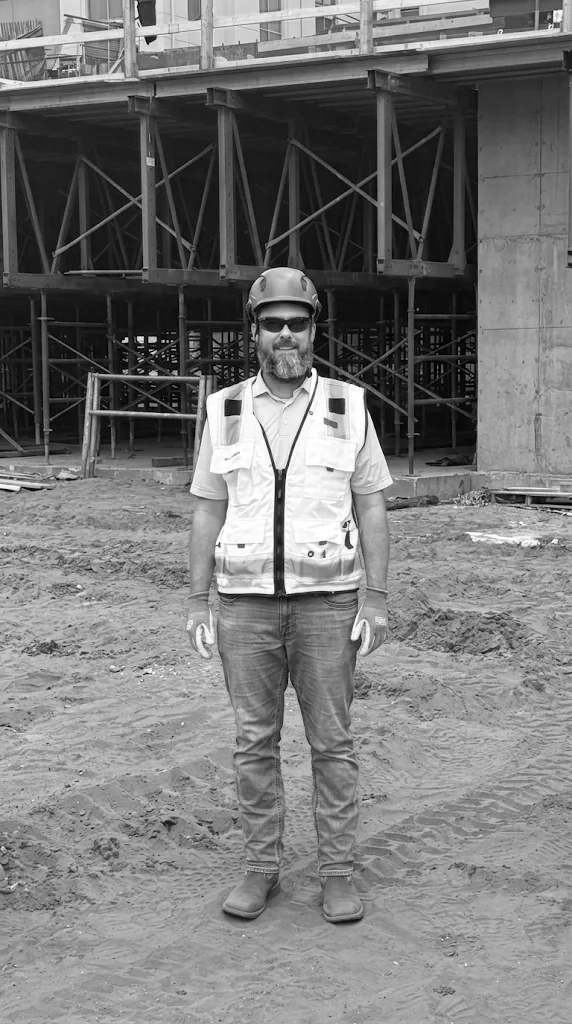
Matt Smith, CSP, construction safety executive, brings a field perspective on access control, worker safety and the challenges of phased occupancy as construction sites transition into operation.The first exposure involves construction workers returning to owner-occupied areas for punch-list work, small changes or owner-requested work. Access must remain possible for approved tasks, with authorization narrowed by room, time and scope. The second exposure runs in the other direction: owner personnel can enter unfinished areas and encounter construction hazards for which they have limited training. Clear physical boundaries and communication rules have to work in both directions.
This is where an old construction-wide access permission can become too permissive. Review zone tiers, escort rules, operating hours, emergency access, work-order sponsorship and entry history before the owner begins occupying spaces. The GC, owner and security team should agree which organization can approve an exception, who can stop access when conditions change, and how each population is informed of the current boundary.
Smith emphasized that a GC needs finished and unfinished areas separated as they are commissioned. Protecting completed rooms from unnecessary construction traffic also clarifies responsibility during transition. The security operating model should capture that transfer of authority explicitly instead of allowing it to follow informal assumptions.
An effective handoff packet contains a zone map showing present control; credential roles and expiration rules; active vendor and punch-list permissions; coverage testing; alerts and response procedures; outstanding incidents and exceptions; and a schedule for retiring temporary systems. The incoming operator should be able to locate that information and make a decision without reconstructing the project’s history.
8) Preserve options when design and schedule change
Security decisions are part of the same dependency chain as construction decisions. Revised entrances, restricted rooms, network access, mounting points or equipment-storage locations can create cost and operating consequences when they surface late. The goal of early planning is to preserve the ability to adapt without forcing improvisation at a critical milestone.
Classify each security choice as necessary now, reversible later, or expensive to change. Early in the build, the project may need power, mounting capacity, conduit, connectivity or approval pathways while retaining flexibility about the eventual device or service. Later, a fully specified and tested system may be required. The investment sequence should follow the maturity of the requirement.
Three stress tests are useful at every major review. If the schedule accelerates by several weeks, can the security team support the increased workforce and delivery flow? If a long-lead component is redirected to offsite storage, can custody, coverage and condition records follow it? If the owner occupies a zone before general completion, are permissions and escalation rights ready for mixed populations? Each answer should specify the decision-maker, required resources and next action.
A project that cannot answer one of those questions has found a management issue early enough to correct. That discovery is the value of treating security as a resource with capacity, lead time, cost and operating constraints.
9) The Build Security Resource Plan: a meeting-ready decision record
Use this short review before each construction phase gate, significant sequence change, critical delivery or partial occupancy milestone. Keep one accountable version of the record and update it as the site changes.
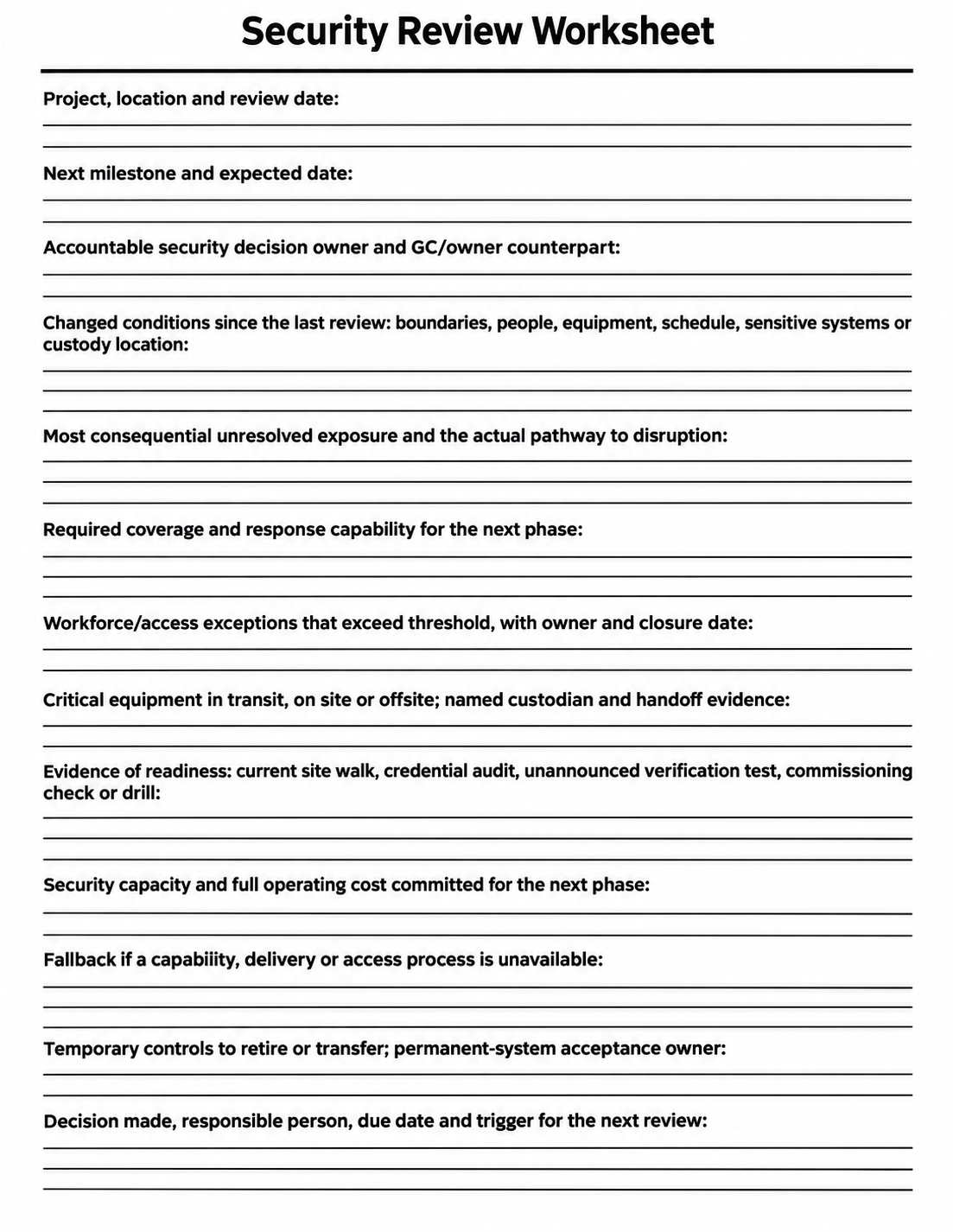
A practical security review worksheet for documenting phase-specific risks, accountable owners, readiness evidence and decisions before major construction milestones.The output should be a decision log, not a score for its own sake. Items with material consequence and no verified owner become the next work package. Low-consequence issues may be monitored or accepted. The plan should make that distinction explicit.
Closing: keep the operating model aligned with the work
The case for a changing construction security posture rests on a practical observation: a project changes faster than a fixed set of assumptions. The research establishes pressure on construction schedules, workforce availability and equipment lead times. Field contributions show how those pressures surface in custody decisions, credentials, phase boundaries and handoff. The Security Resource Plan connects the evidence to a repeatable choice about capability, accountability and timing.
Security contributes most when it helps the project answer the next important question with verified information and a person empowered to act. A phase-based resource plan gives leadership a way to preserve that capability from mobilization through early operations.
For owners or contractors who want to pressure-test their next milestone, Deus X Defense offers a complimentary 30-minute Build Security Readiness Review and a short gap summary focused on the smallest credible next operating improvement.
Sources and contributor basis
Data and externally published material
[1] JLL, 2026 Global Data Center Outlook (January 2026), pp. 24-25.
Contributor perspectives
Rob Chadwick: original build-phase planning and subsequent written operational guidance on access mismatches, testing, weekly management measures, verification and commissioning (2026). This is practitioner judgment, not a quantified independent study.
Matt Smith, CSP, construction safety executive: professional observations and revised wording contributed in October 2026 on critical deliveries, offsite equipment storage, phased occupancy and handoff. These are Smith’s individual professional perspectives; no organizational affiliation or endorsement is asserted.
Research interpretation
JLL and AGC/NCCER figures describe industry conditions. They do not establish that a particular security investment prevents construction delays or quantify its return. The operational measures in this paper are proposed project controls and should be validated locally. Sources accessed November 2, 2026.
